
Most EUC teams now operate in a hybrid reality. Applications, from legacy software to SaaS, must be available across physical endpoints, VDI environments and cloud desktops.
Application management is still often still designed according to a model from another era: package applications, bake them into images, and deploy them using traditional tooling. That approach worked when environments were relatively homogeneous, but in a hybrid IT landscape it is becoming increasingly difficult to sustain.
The Cost and Risk of Traditional Application Management
A significant share of operational pressure within EUC teams comes from application management. Applications need to be packaged, tested and integrated into images. Updates to applications, Windows versions and management agents mean the process has to be repeated again and again.
The scale of the challenge becomes clear when looking at an application such as Firefox. Mozilla releases around 13 major versions per year, alongside 20 to 30 minor updates. Even organisations opting for the Extended Support Release still face roughly 15 releases annually.
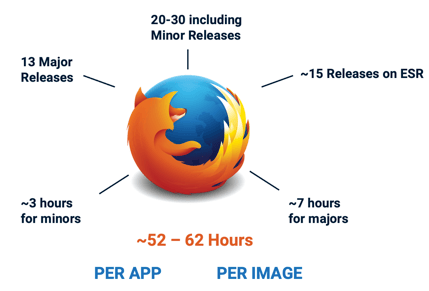
If every update requires repackaging, retesting, and redeployment, a single application can consume several days of administration each year. Multiply that by dozens or hundreds of applications in an enterprise environment, and it becomes clear where much of the operational strain within EUC teams originates.
At the same time, updating is not optional. The majority of security incidents still stem from vulnerabilities in unpatched applications. Yet every update also introduces new compatibility and stability risks.
The Image Problem
A common side effect of this approach is image sprawl. Different departments require different combinations of applications. Finance needs one set, engineering another, contractors yet another.
The result is a growing number of images, all of which must be maintained, tested and redeployed whenever applications change.
In a hybrid IT environment, where applications must function across multiple platforms,this model becomes increasingly difficult to manage.
A Different Approach to Application Delivery
More organisations are therefore moving away from the idea that applications should be embedded in the OS image. Instead, applications are decoupled from the underlying operating system. One of the most effective ways to achieve this is through application layering.
With application layering, an application is packaged into a separate layer that can be dynamically attached to a user. The layer contains all files, registry settings and dependencies required for the application to function.
The key difference from traditional packaging is that the application is no longer tightly bound to the OS image — and therefore less dependent on a single platform.
An application no longer needs to be repackaged for every image or infrastructure type.
Package Once, Deliver Anywhere
When applications are available as layers, the delivery model becomes significantly more flexible. The same application can be used across physical endpoints, VDI environments or cloud desktops such as Azure Virtual Desktop and Windows 365.
Application delivery also becomes more dynamic. An application can load automatically at user logon, only when it is launched, or even at system startup if required.
This makes it possible to deliver applications dynamically without permanently embedding them into the underlying system.
Less Complexity, More Freedom
By separating applications from images, organisations create a model that scales more effectively for modern workspace environments. Images remain clean and simple, applications can be updated independently, and IT teams no longer need to maintain multiple environment variants.
Perhaps more importantly, organisations retain greater flexibility in their infrastructure choices. Because applications are no longer tightly coupled to a specific platform, it becomes easier to operate multiple technologies side by side — or change direction in the future.
Hybrid IT ultimately requires more than new technology. It requires a different way of thinking about applications — not as static components baked into images, but as flexible services that can be delivered dynamically.
For EUC teams, that means less complexity, reduced risk and far greater control over how applications are delivered.
👉 Want to learn more?
Book a session with the Liquidware team or get in touch to explore how FlexApp can support your application management strategy!